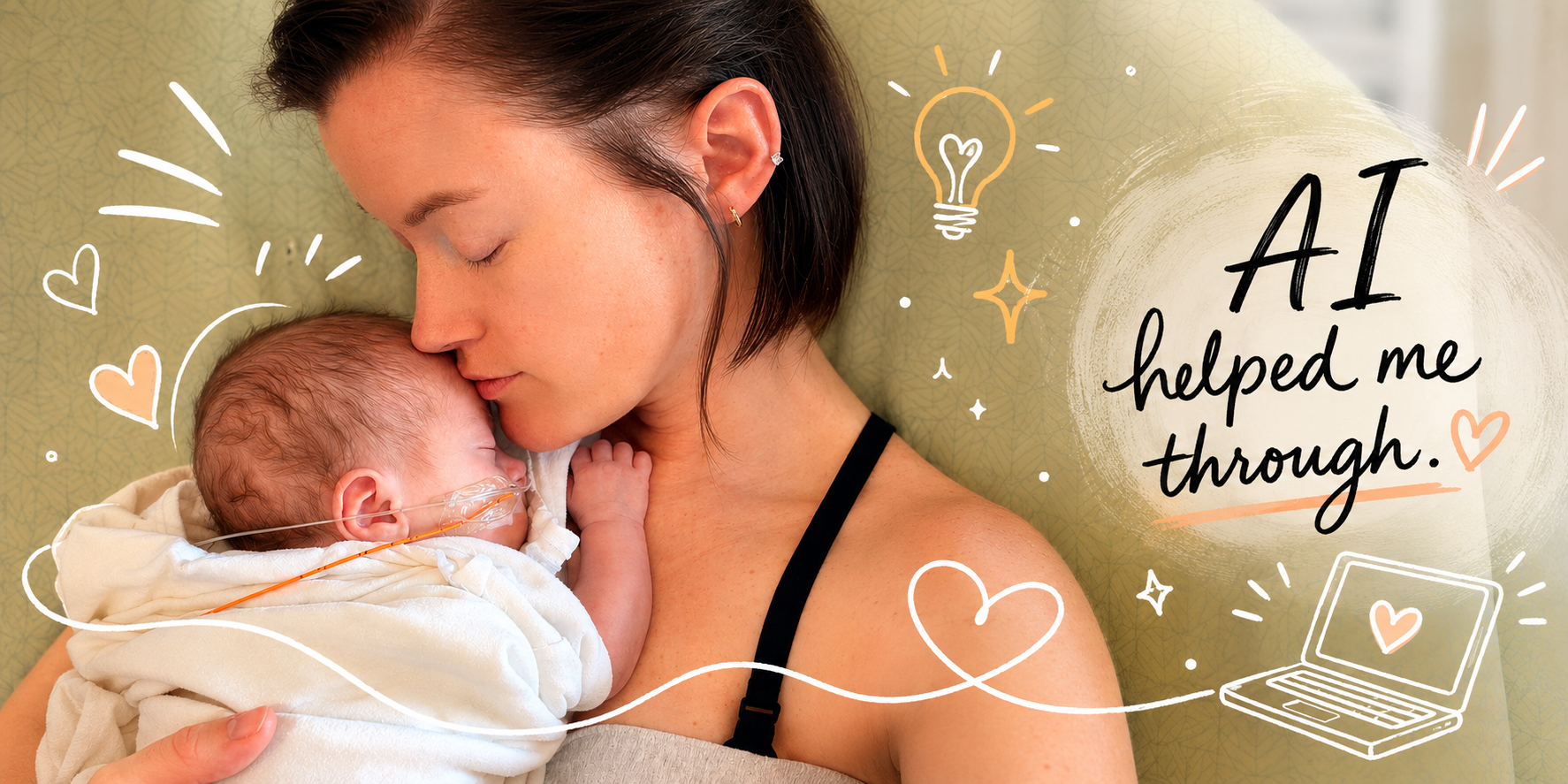
When people talk about artificial intelligence, they usually talk about productivity, marketing, content creation, or automation. What they don’t talk about enough is how AI can help during some of life’s hardest moments.
A few months ago, my son Miles spent time in the NICU. Like many NICU parents, I found myself living in a world full of medical terminology, feeding schedules, specialist appointments, growth charts, medications, and endless questions.
The doctors, nurses, dietitians, therapists, and specialists were incredible. But between rounds, appointments, and late-night worries, I often found myself needing help understanding what was happening and what questions I should be asking.
That’s where AI unexpectedly entered the picture and where this blog starts to overlap with a large portion of my life; motherhood. So grab your afternoon coffee as we dive into the use of AI as a parent in this Friday’s post.
AI Didn’t Replace Medical Experts
Let me be clear that AI was never making decisions about my son’s care, his medical team did that. Instead, AI became a tool that helped me process information, organize my thoughts, and better understand the complex medical world we had suddenly been dropped into.
Think of it less like a doctor and more like a medical translator.
Jargon Into Plain English
NICU life comes with a vocabulary most parents never expect to learn. Between terms like adjusted age, fortified feeds, weight gain velocity, calorie density, oral feeding readiness, developmental milestones, and so much more, it can be a lot to adjust to when you were already preparing for all the newness of just becoming a parent of a newborn.
I constantly found myself hearing terms that were technically explained but still difficult to fully understand at the moment. After conversations with specialists, I’d often use chatGPT or Claude to help break concepts down into simpler language. It helped me understand what terms meant, how different treatments worked, and what questions I might want to ask during our next meeting with the doctors. This truly help me become an informed advocate for my son.
Helping Me Prepare for Appointments
One of the biggest challenges as a NICU parent is that you’re often making decisions while emotionally exhausted. There were days when I’d think of ten questions I wanted to ask a doctor and then completely forget half of them when the time actually arrived.
AI became a brainstorming partner. I’d explain a situation and ask:
- What questions should I ask the doctor?
- What topics should I discuss with the dietitian?
- What information might be helpful to track before the next rounds session?
- What are common things parents ask in similar situations?
Many times it surfaced questions I hadn’t considered. That made me feel more prepared and more confident going into conversations with medical professionals.
Finding Balance Between Information and Anxiety
If you’ve ever Googled a medical concern at 2 a.m., you know how quickly a simple search can spiral. One symptom turns into ten possible diagnoses and one article leads to another. Before long you’re convinced the worst-case scenario is inevitable.
ChatGPT made these searching sessions feel completely different. Instead of sorting through dozens of conflicting articles, I could ask specific questions and get organized explanations that helped me better understand the situation without disappearing down an internet rabbit hole.
It definitely wasn’t perfect but it still helped me feel organized and prepared on what to verify with the medical professionals. And more importantly, it helped reduce the sense of overwhelm more than a few times.
Organizing Notes and Tracking Progress
During the NICU stay and after discharge, there was so much information to keep track of; weight tracking, feed volumes, formula adjustments, fortifying amounts, specialist recommendations, and appointments. ChatGPT helped me organize notes, summarize conversations, and make sense of information spread across multiple areas.
When you’re sleeping in short stretches and trying to care for a newborn, even basic organization can feel difficult. Having such a tool that could help synthesize information became surprisingly valuable.
The Human Side of Technology
As someone who works in marketing, I spend a lot of time thinking about AI’s impact on business. But during this season of life, I experienced something different. I experienced AI as a support system, not with associated emotions, but helping me process information during a time when my brain was overloaded with stress, fear, hope, and exhaustion.
Technology often gets framed as either revolutionary or dangerous but the reality is usually somewhere in the middle. For me, AI wasn’t magic and it didn’t replace the very real human experience my family was going through. But it did help me become a more informed parent, a better advocate for my son, and a little less overwhelmed during one of the most challenging experiences of my life.
Final Thoughts
AI is often at its best when it helps humans do what they already do, and possibly do it better. For marketers, that might mean creating content more efficiently. For business leaders, that might mean analyzing data faster.
For me, during Miles’ NICU stay, it meant helping me understand, organize, and navigate an incredibly complex journey.


Leave a Reply