
Every few years, marketing gets a new acronym that suddenly makes everyone feel like the old playbook is dead.
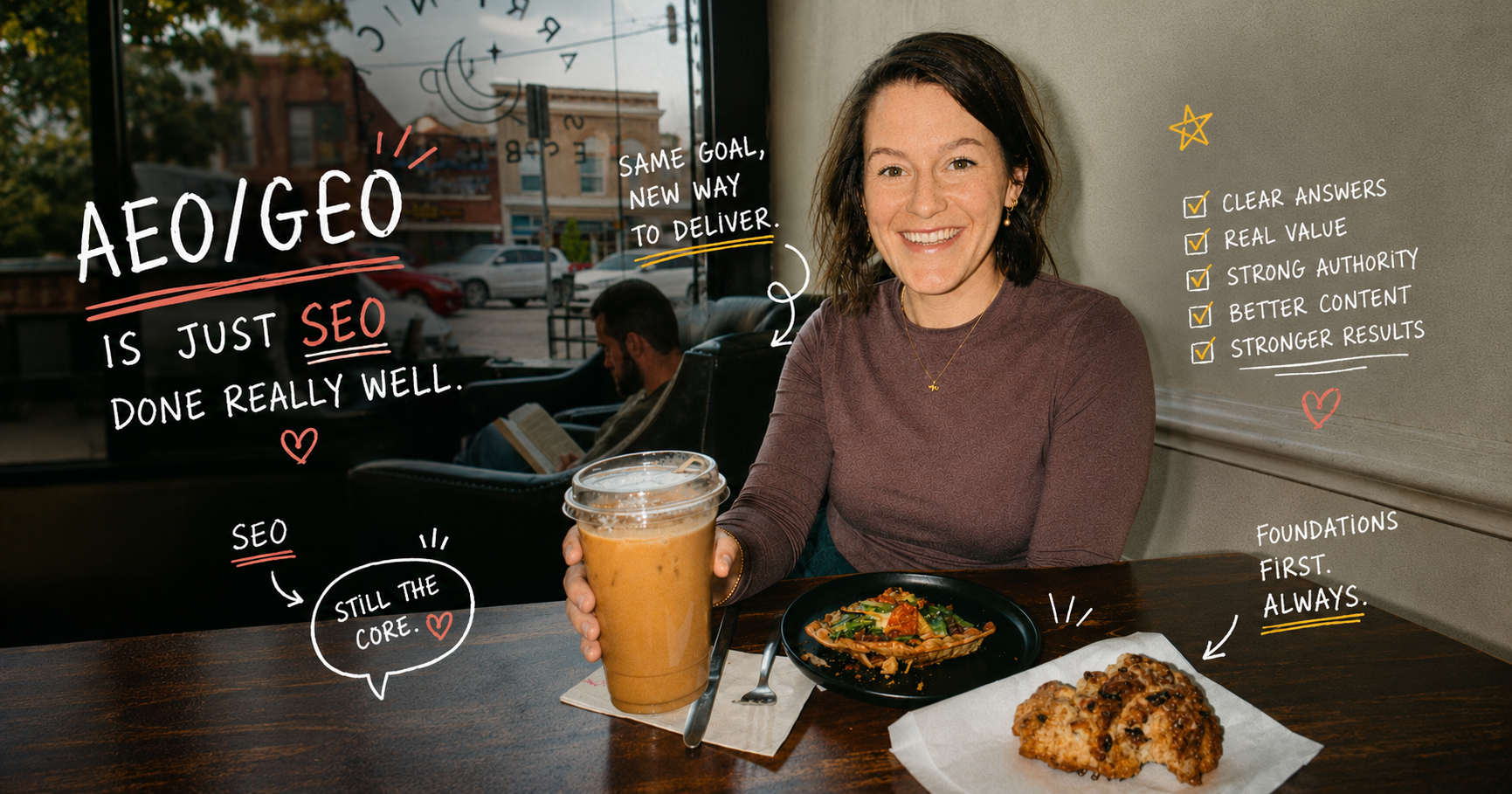
At this moment, it’s AEO (Answer Engine Optimization) and GEO (Generative Engine Optimization). And if you’ve spent even five minutes on LinkedIn lately, you might be believing that traditional SEO is completely irrelevant now that AI search is here. But the truth… AEO/GEO is not replacing SEO at all.
If you break down the practices that are getting brands and businesses mentioned on LLMs, it’s still just SEO done really well. The brands showing up in ChatGPT responses, Google AI Overviews, Perplexity, and other AI-driven search experiences are usually the same brands that already had strong content, clear messaging, and solid SEO foundations. Because while the format of search is evolving, the core principles behind visibility really haven’t changed as much as people think they have.
The delivery method changed and the search experience changed, but the fundamentals are still the fundamentals. The basics are still what you want to focus on. (And not to mention that traditional search is still around and Google still dominates daily search volumes!)
Search Engines and AI Models Want the Same Thing
At the end of the day, both traditional search engines and AI models are trying to accomplish the exact same goal: give users the best possible answer.
Whether someone is typing a question into Google or asking ChatGPT for recommendations, the system is looking for content that is helpful, trustworthy, clear, and relevant. That’s why so many of the same best practices still apply.
The content that performs well today is content that genuinely answers questions, explains things clearly, demonstrates expertise, and is easy to digest. It’s content that understands search intent instead of just chasing keywords.
For years, good SEO professionals have been saying that SEO is really about creating the best resource on a topic. AI search doesn’t suddenly change that philosophy. If anything, it reinforces it.
AI Search Rewards Clarity More Than Ever
One thing that is changing is how important clarity and structure have become.
AI tools need content they can easily interpret, summarize, and pull information from. Which means vague, fluffy marketing copy is becoming even less effective than it already was. The brands winning in AI search are often the brands communicating the most clearly.
Pages with strong headings, direct explanations, organized formatting, and well-structured information are simply easier for AI systems to understand and reference. And honestly, they’re also easier for humans to read too.
I think this is forcing marketers back toward stronger content fundamentals. Not necessarily creating more content, but creating better content. More intentional content. More useful content.
Because when AI is scanning thousands of pieces of information trying to generate the best answer, clarity matters.
Authority Matters More Than Ever
Another thing I keep seeing people overlook is how heavily AI systems rely on trust and authority signals.
AI tools don’t want to confidently provide bad information. So naturally, they lean toward brands and sources that already appear credible across the internet. That includes things like strong brand reputation, backlinks, topical authority, consistent messaging, expert insights, and overall digital trust signals.
Again, none of this is new.
This is the same foundation SEO experts have talked about for years. The difference is that now those trust signals don’t just help you rank on a search engine results page, they can also influence whether your brand becomes part of an AI-generated answer.
If anything, authority is becoming even more important because AI systems are designed to reduce uncertainty. The more consistently your brand shows up as a credible source across the web, the more likely it is to be surfaced in these newer search experiences too.
GEO Isn’t About Writing for Robots
I think one of the biggest mistakes marketers are making right now is trying to “optimize for AI” by creating robotic, over-engineered content. Ironically, that usually makes the content worse.
The brands that are going to win in this next era of search are the ones creating genuinely helpful content written by people who deeply understand their audience. Content that sounds human. Content that offers original perspective. Content that actually says something meaningful.
AI systems are getting increasingly good at identifying depth, expertise, context, and usefulness. Which means surface-level content is becoming easier and easier to ignore.
You can’t shortcut your way into authority with AI-generated fluff. And I think a lot of marketers are about to learn that the hard way.
The Best GEO Strategy Is Still a Strong Content Strategy
If you want your brand to show up in AI-generated answers, summaries, citations, and conversational search experiences, the answer probably isn’t some completely new secret optimization framework.
It’s still about publishing high-quality content consistently. It’s still about answering real customer questions. It’s still about building topical authority, improving your website experience, strengthening your brand trust, and becoming a credible source within your niche.
That’s why I keep coming back to the same conclusion: GEO is really just SEO done exceptionally well.
The marketers who are going to succeed over the next few years won’t be the ones abandoning SEO fundamentals in favor of every new AI buzzword. They’ll be the ones who understand how AI search is evolving while still mastering the basics.
Because the future of search probably doesn’t belong to marketers who chase algorithms. It belongs to marketers who create genuinely valuable content that people, and AI systems, actually trust.
Stay tuned for a future post on simple implementation practices for SEO, AEO, & GEO.


Leave a Reply