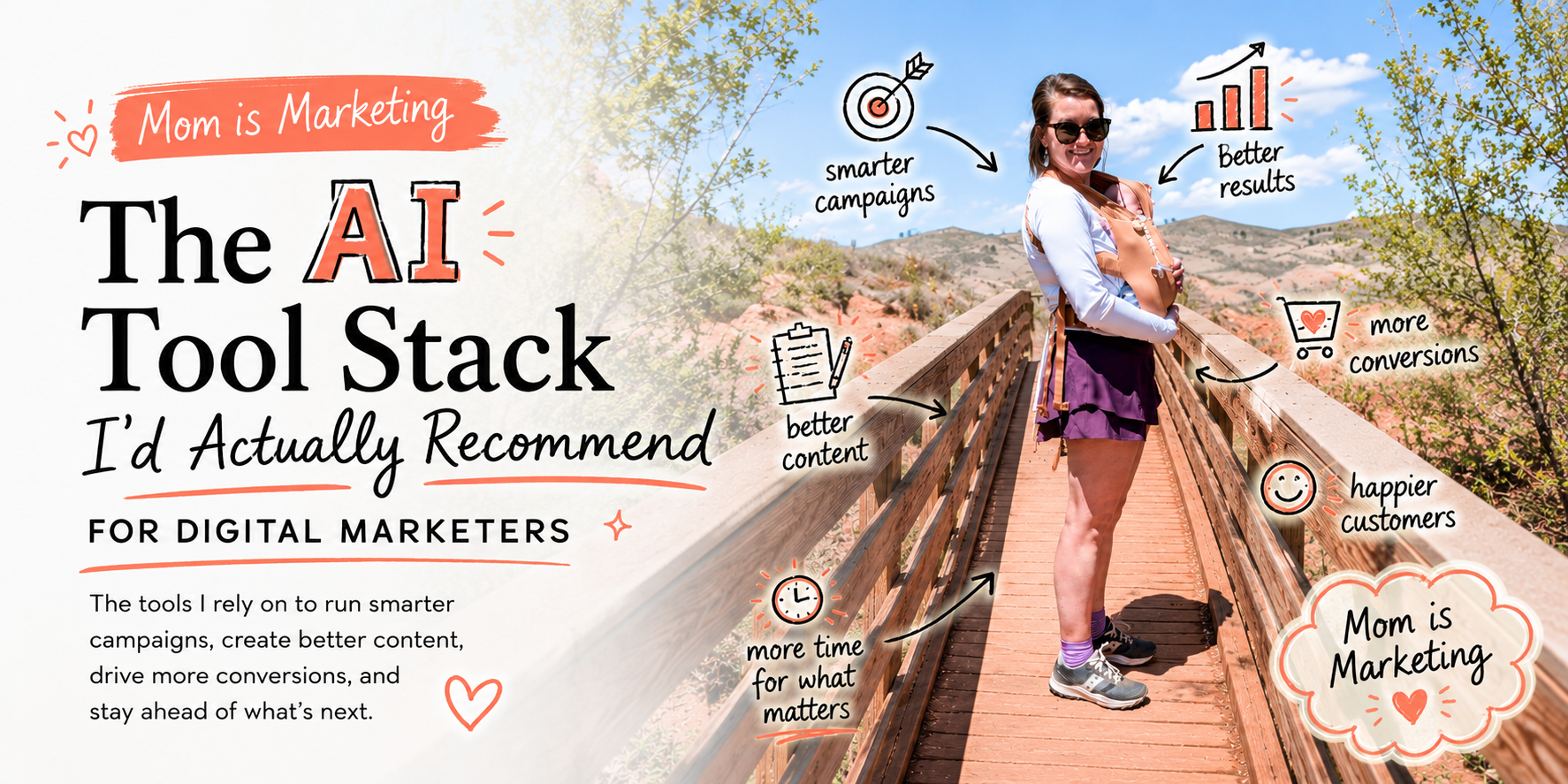
I’ve been on maternity leave for a hot minute recently and that has given me some time during baby naps to dive into the different AI tools on the market. It’s been fun having the flexibility to dabble into more options than I’d typically get the chance to.
There was a point where simply saying you “used AI” in marketing felt innovative. Now, it’s just the starting point. The real shift happening in marketing isn’t whether teams are using AI, it’s how they’re using it and whether they’re building workflows that are actually smarter, faster, and more scalable.
Digital marketing moves too quickly for entirely manual systems and it’s been like that for a while. Between paid media optimization, content distribution, SEO changes, conversion tracking, and social media management, marketers are expected to make real-time decisions constantly. AI is becoming less of a “nice-to-have” tool and more of an operational necessity. And the best marketers aren’t using AI to replace creativity, they’re using it to remove bottlenecks, surface insights faster, and spend less time buried in repetitive execution work.
Here’s the AI tool stack I think digital marketers should actually be paying attention to right now.
Note: None of the tools mentioned in this post are sponsored, and all recommendations are independently selected based on my own testing and experience.
Paid Media & Ad Optimization
Paid media has changed dramatically over the last few years. Running campaigns manually across Google, Meta, TikTok, and other platforms is becoming increasingly inefficient, especially as algorithms, audience behavior, and bidding systems evolve in real time. Digital marketers are now expected to optimize creative, budgets, targeting, and performance simultaneously, often across multiple channels at once.
That’s where AI-powered advertising tools are changing the game.
Albert.ai
Albert.ai is one of the strongest examples of how automation is reshaping paid media management. Instead of relying entirely on human oversight for campaign adjustments, the platform continuously analyzes performance data and autonomously reallocates budget, adjusts targeting, and optimizes campaigns across channels. It essentially acts as an always-on optimization layer that works around the clock.
For digital marketers, this doesn’t eliminate strategic thinking, it actually creates more room for it. Instead of spending hours manually adjusting bids or analyzing campaign fluctuations, teams can focus more heavily on creative direction, audience psychology, and larger growth strategy.
AdCreative.ai
Creative production has become one of the biggest bottlenecks in digital advertising. Platforms reward frequent testing, but constantly generating new visuals and ad copy can quickly overwhelm even experienced teams.
AdCreative.ai uses AI to generate conversion-focused ad creatives based on historical performance patterns and predictive modeling. Rather than guessing which headlines or layouts might work, marketers can quickly produce multiple creative variations designed around what audiences are statistically more likely to engage with.
And honestly, speed matters now more than perfection. The brands winning in paid media are often the ones testing faster and learning faster.
Smartly.io
As advertising ecosystems become more fragmented, cross-platform management becomes increasingly complex. Smartly.io helps enterprise and scaling brands automate ad creation, campaign execution, and bidding strategies across platforms like Meta, TikTok, Pinterest, and Snapchat.
What makes tools like this important isn’t just efficiency, it’s scalability. Digital marketing teams are being asked to produce more campaigns, more assets, and more personalization without necessarily growing headcount at the same pace. AI-driven automation helps close that operational gap.
SEO & the Rise of Semantic Search
SEO is no longer just about ranking for a keyword.
Search behavior itself is changing. Between Google AI Overviews, conversational search experiences, and AI-powered platforms like Perplexity, users are interacting with information differently than they did even two years ago. Google recently reinforced this shift by sharing that people are increasingly searching with longer, more conversational phrases instead of just typing in a few keywords. That means marketers have to think beyond traditional keyword density and start focusing on topical authority, semantic relevance, natural language patterns, and answer-driven content structures.
The future of SEO is becoming increasingly contextual.
Surfer SEO
Surfer SEO helps marketers understand how modern search engines interpret content semantically. Instead of simply recommending keywords, the platform analyzes live search engine results pages and identifies the topics, structures, and contextual relationships currently performing well.
What I appreciate about tools like this is that they push marketers toward building genuinely comprehensive content instead of creating articles designed purely to manipulate algorithms. Search engines are becoming better at understanding intent and topic depth, which means shallow optimization tactics are losing effectiveness quickly.
MarketMuse
One of the biggest challenges for brands today is understanding where their content strategy has gaps. Many websites have disconnected blog posts without a clear topical structure tying them together.
MarketMuse helps identify areas where competitors are building stronger authority and where your own website may be missing key supporting content. Instead of focusing on isolated articles, it encourages marketers to think about content ecosystems and long-term authority building.
And that matters more than ever in AI-driven search environments.
Why AI Search Visibility Matters
This is one of the most important shifts shaping search strategy right now. It’s no longer just about ranking on page one of Google. Brands also need to consider whether their content is being surfaced, cited, or synthesized by AI systems inside generated answers.
And at the same time, the rise of AI tools and chat-based interfaces is changing how people actively use and interact with information. Users are increasingly asking questions directly inside AI platforms rather than navigating through traditional search results. That means content is being evaluated in two directions at once: what gets pulled into AI-generated answers, and what gets surfaced in real-time conversational workflows.
That shift changes how content is structured, how authority is signaled, and how visibility is measured across the entire search ecosystem.
Conversion Rate Optimization & Personalization
One of the most expensive mistakes in digital marketing is driving traffic to experiences that don’t convert.
Marketers spend enormous amounts of energy acquiring clicks, impressions, and website visitors but if landing pages, messaging, or user journeys aren’t optimized effectively, that traffic becomes incredibly inefficient.
AI-powered personalization and CRO tools are helping brands improve the actual user experience in much more sophisticated ways.
Mutiny
Mutiny allows marketers to personalize website experiences dynamically based on who is visiting the site. A healthcare buyer may see different messaging than a SaaS founder or an ecommerce executive.
That level of personalization once required extensive development resources and large internal teams. AI is making it significantly more accessible.
What’s powerful about this shift is that digital experiences are becoming more adaptive. Instead of one static website attempting to speak to everyone equally, brands can create experiences that feel more aligned to individual visitor intent.
VWO
Conversion optimization has historically been a slow process filled with assumptions and lengthy testing cycles.
VWO uses AI-powered experimentation and predictive analysis to help marketers identify where users disengage, where friction exists, and which landing page variations are most likely to improve performance.
The reality is that even small conversion improvements can dramatically impact revenue over time. AI simply allows teams to identify those opportunities faster and with more precision.
Social Media Management & Social Listening
Social media marketing has evolved far beyond simply posting content consistently. Brands are now expected to monitor conversations in real time, respond quickly, maintain platform-specific strategies, repurpose long-form content efficiently, and understand audience sentiment across multiple networks simultaneously.
That creates a massive operational workload.
Brand24
Brand24 uses AI-powered social listening to monitor mentions across the web and analyze emotional sentiment surrounding a brand. It can identify whether conversations are trending positively, negatively, or neutrally and alert teams before minor issues escalate into larger PR problems.
In a digital environment where brand perception can shift quickly, tools like this become incredibly valuable for staying proactive instead of reactive.
Lately.ai
One of the smartest shifts marketers can make right now is maximizing the lifespan of their existing content.
Lately.ai takes long-form assets like podcasts, webinars, blog posts, or interviews and repurposes them into multiple platform-optimized social posts automatically. Instead of constantly creating from scratch, marketers can scale content distribution much more efficiently.
And honestly, this is where I think AI is most useful for marketing teams: reducing repetitive execution work so people can focus more heavily on strategy, storytelling, and creative direction.
The Real Competitive Advantage Isn’t AI Alone
The biggest misconception about AI in marketing is that the tools themselves are the advantage. They’re not.
The real advantage comes from knowing how to integrate these tools into smarter systems and workflows. Success over the next few years will be for those who understand strategy deeply enough to guide AI effectively, not simply automate blindly. Because at the end of the day, marketing is still human.
AI can optimize distribution, it can analyze patterns, and it can speed up execution. But it still takes human insight to understand people, emotion, trust, community, and connection.
And that balance between strategy, systems, and humanity is also very aligned with everything I want Mom is Marketing to represent.


Leave a Reply